
Hardly any yard in Serbia is perfectly flat. The ground drops towards the street, rises towards the neighbour, in one spot it’s concrete, in another compacted earth, and somewhere else old, crumbling base. And it’s precisely there, on that “less-than-ideal” ground, that ordinary fences and gates start to struggle — they leave ugly gaps at the bottom, warp, or the gate opens with a catch. The good news is that there are smart solutions for all of it; you just need to know which ones and apply them properly.
At Alu kramil we’ve been working on all kinds of terrain since 2003, so we’ve learned that a slope isn’t an obstacle but a question of the right approach. In this article we explain how fences and gates are adapted to slopes and unevenness, and why aluminium is often the best choice exactly here.
Why a slope causes problems for ordinary solutions
When the ground is flat, a fence is simple — all the lines are horizontal and everything “lines up”. As soon as a slope appears, two problems arise. The first is aesthetic and practical: if the fence is kept strictly horizontal, a gap is left at the bottom on the lower part of the ground, through which dogs, small animals and prying eyes can pass; if it follows the ground without a plan, it can look crooked and sloppy. The second problem is the gates: a swing gate that opens in an arc on an upward slope either catches on the ground or has to be lifted uncomfortably high.
This is where the experienced contractor is set apart from the one who works “as if it were flat”. A slope has to be measured and planned in advance — how much of a fall, on which part, and how you want the top line of the fence to look. That isn’t sorted by eye, on the spot, but thoughtfully, before production. So on demanding terrain the visit and the measuring aren’t a formality but the essence of the job.
Uneven terrain also brings the question of the base. Anchoring a post in firm concrete and in soft, filled-in soil are not the same thing. If that’s neglected, the fence starts to “work” and lean after the first winter or heavy rain. That’s why we always look at both the slope and the base — because both decide which solution will truly last.
Fences on a slope — two approaches
For fences on a slope there are two good approaches, and we choose between them according to how you want the fence to look. The first is “stepped” — the fence descends the slope in steps, where each segment stays horizontal and the transitions between segments follow the fall of the ground. That gives a tidy, “architectural” look and sits nicely on steeper slopes. The second approach is for the fence to follow the ground — the top line drops gently along with the terrain, with no steps, which feels more natural on gentle falls.
Vertical infill is especially rewarding on a slope, because it adapts easily to both approaches and keeps a tidy look with no ugly gaps at the bottom. Panel and solid fences call for a little more care on a steeper slope, but we solve that too — it’s just important that the approach is chosen in advance. The point is that a slope needn’t be a flaw; with the right approach, a fence on sloped ground can look even more striking than one on the flat.
What we never do is force a level fence into place and leave gaps or curves. We plan each segment according to the actual fall, so the result looks as if the terrain had always been that way. That’s the difference between a fence tailored to your yard and one that “fights” it every single day.
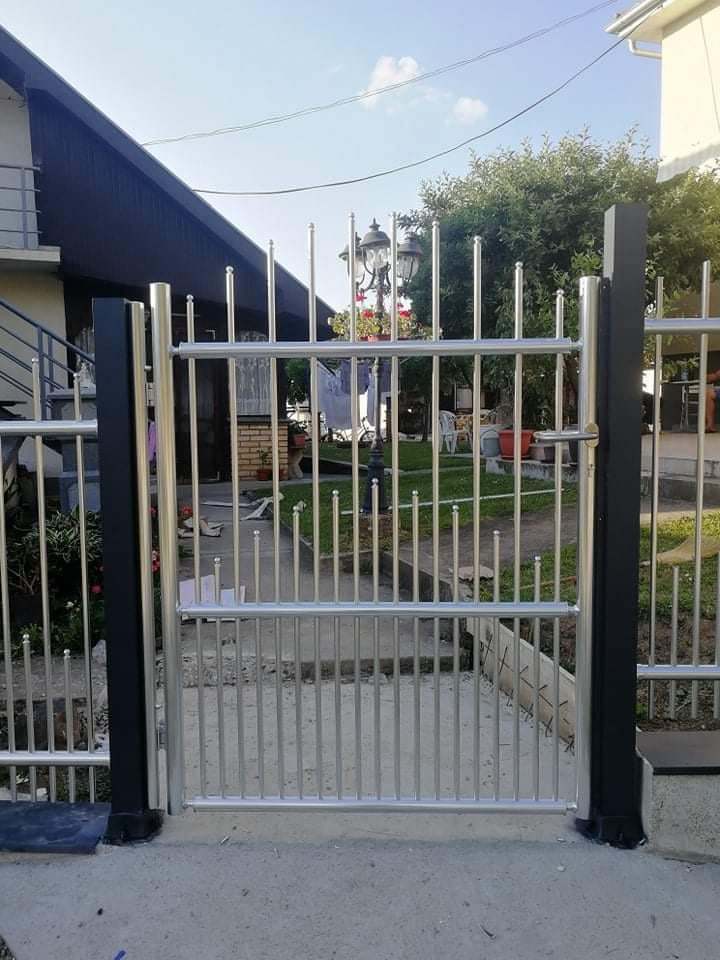
Gates for a slope — why sliding and cantilever win
With gates, a slope is even more delicate than with fences, and here the choice of type is decisive. A swing gate opens in an arc, so on an upward slope the leaf either catches on ground that rises or has to hang high above it — neither is good. That’s why on a steeper slope we usually don’t recommend a swing gate.
A sliding gate moves sideways, parallel to the fence, so it copes with a slope far better — it doesn’t have to “cross” anything in an arc. And the queen of uneven terrain is the cantilever gate: it doesn’t touch the ground at all but “floats”, carried by a side structure. Since it has no rail or support on the ground, it works perfectly on uneven, soft or sloped terrain, and neither snow nor mud gets in its way. For yards that are both sloped and have serious winters, a cantilever gate is often the only solution that works flawlessly all year round.
So if your driveway is on a slope, think in the direction of a sliding gate, and especially a cantilever one. A swing gate remains an option only on a gentle fall and where there’s enough flat space to open it. As always, the exact choice depends on how much of a slope there is and what the space is like — and we see that best in person.
Why aluminium is ideal on demanding terrain
On a slope and unevenness the weight of the material becomes important, and here aluminium shows its advantage. It’s lighter than iron, so it puts less strain on the posts and foundations — which matters especially when the base isn’t ideal. With cantilever gates, where the structure carries all the weight via a counterbalance, aluminium’s lightness directly means more reliable and longer-lasting operation. A heavy iron gate on the same terrain would be a greater challenge for both the structure and the motor.
On top of that, aluminium doesn’t rust — and on uneven terrain, where water sometimes lingers and moisture is a bigger factor, that’s a serious advantage. Where iron would deteriorate faster in such spots, aluminium stays the same. And of course it comes in any colour, so a fence on a slope blends nicely with the house just as it would on the flat.
All in all, demanding terrain is no cause for worry — on the contrary, it’s the situation where quality workmanship shows most. If you have a slope, unevenness or a poor base situation, the best thing is for us to look in person and propose an exact solution. ☎ Call +381 62 384 667 or send an enquiry — the visit and the assessment are free and with no obligation, and you get a fence or gate that will work as it should on your terrain, for years.
What we look at on site with a demanding plot
When we come out to a plot that isn’t flat, we don’t just measure the length and height — we read the terrain. First we look at how much of a fall there is and whether it’s even or broken up in parts; that decides whether we go stepped or following the ground, and exactly where we place the posts. Slopes rarely fall “in a straight line”, so we carefully note where the lowest and where the highest point of each side is.
Then we assess the base, because it decides the anchoring. Firm concrete, filled-in soil, rock or a mix — each calls for its own approach. Where the soil is soft or filled in, the posts go deeper and with a stronger foundation, so the fence doesn’t begin to lean over time. We also look at how water drains down the plot, because on a slope moisture can linger in certain spots — another reason why aluminium, which doesn’t rust, has the advantage here.
With a gate we particularly measure the space and the fall right at the entrance, because that’s where most mistakes are made. We check whether there’s room to the side for a sliding or cantilever gate to retract into, and how the driveway continues beyond the gate. All of that together gives a picture on which we base a solution that will really work — rather than one that looks good on paper and then struggles with the terrain. It’s precisely because of these details that we insist on seeing the plot in person before every quote.
Frequently asked questions
Can an aluminium fence follow the slope of the ground?
It can — either stepped (in horizontal segments down the fall) or following the ground. Vertical infill is especially suitable and keeps a tidy look with no gaps at the bottom.
Which gate is best for a slope?
A sliding gate, and especially a cantilever one, because they move sideways and don’t have to “cross” anything in an arc. A swing gate struggles on a steeper slope.
What is a cantilever gate and why is it good for uneven terrain?
It’s a sliding gate that doesn’t touch the ground but “floats” on a side structure. There’s no rail on the ground, so slope, unevenness, snow and mud don’t get in its way.
What if my base is soft or filled-in soil?
Then proper anchoring of the posts is key. On site we assess the base and choose the anchoring method that will hold firm.
Does a fence on a slope look worse?
Not necessarily — with the right approach it looks tidy, sometimes even more striking than on the flat. Ugly gaps and curves are a sign of poor planning, not of the slope.
Why aluminium on a slope in particular?
It’s lighter, so it puts less strain on the posts and foundations, it doesn’t rust (important where moisture lingers) and it’s ideal for cantilever gates. On top of that it comes in any colour.
Can a swing gate work on a slope at all?
On a gentle fall and with enough flat space — yes. On a steeper slope it’s better to choose a sliding or cantilever gate.
Is installation on a slope more expensive?
It can be, because it calls for more preparation and sometimes a stronger structure. We tell you that clearly in the quote, broken down item by item.
Do you measure the terrain before the quote?
Always — with slopes and unevenness a quote “over the phone” makes no sense. The visit and measuring are free.
How do I get a solution for my terrain?
Call +381 62 384 667 or send an enquiry. We come out, look at the slope and the base and propose an exact solution with no obligation.
Related topics
- Sliding gates and cantilever gates — best for slopes
- Vertical fences — adapt easily to the fall of the ground
- Aluminium fences (overview)
- How a fence is measured and installed
- Aluminium gates